---
title: "When Is a Ransom Worth Paying?"
subtitle: "A Game-Theory Guide for the Board: Summary"
author: Patrick Lefler
date: November 19, 2026
---
```{r setup}
#| include: false
source("R/00_params.R"); source("R/01_utils.R"); source("R/90_theme.R")
library(dplyr); library(ggplot2); library(gt)
wa <- read_result("walkaway")
mc <- read_result("mc_drivers")
rep <- read_result("reputation")
sh <- mc$shares
share_of <- \(tgt, v) sh$share[sh$target == tgt & sh$input == v]
g <- rep$grid |> filter(abs(p0 - P$reputation$p0_base) < 1e-9)
cost_of <- \(f, pol) g$cost_10y[g$firm == f & g$policy == pol]
fr <- wa$profiles |> filter(profile == "fragile")
ref <- wa$ref
R_of <- \(cs) ref$R_star[ref$case == cs]
dv <- rep$deviation
pv_of <- \(e, f, pol) dv$cost_10y_pv[dv$eta == e & dv$firm == f & dv$policy == pol]
eta_b <- P$reputation$eta_base
```
*All money is in $M and all values are illustrative. The firm is synthetic.*
## Introduction
::: {.board-question}
> "If we're hit, should we pay, and how do we decide before it happens?"
:::
This site works through that question for a 500-person fintech software firm, the same firm as our Defender–Attacker study. A ransomware crew has encrypted the firm's production platform and copied its client data. The firm must choose between paying the crew's demand and restoring from backups. We model that choice as a bargaining game in which the crew does not know how badly we need to pay, and learns from what we do.
The answer, in three sentences:
1. Every firm has a **walk-away point**: the largest ransom worth paying, after allowing for a decryptor that may fail, sanctions exposure, the costs of paying, and the leak risk that remains either way.
2. That point is set by **how long it takes to restore**; the size of the demand only tests it. Each day cut from restore time lowers it by about `r fmt_m(wa$slope, 2)`.
3. Resilience therefore does two jobs: it lowers the cost of an outage, and it makes a "we don't pay" policy **credible**, so crews that learn over repeated incidents attack less often.
```{r}
#| label: fig-hero
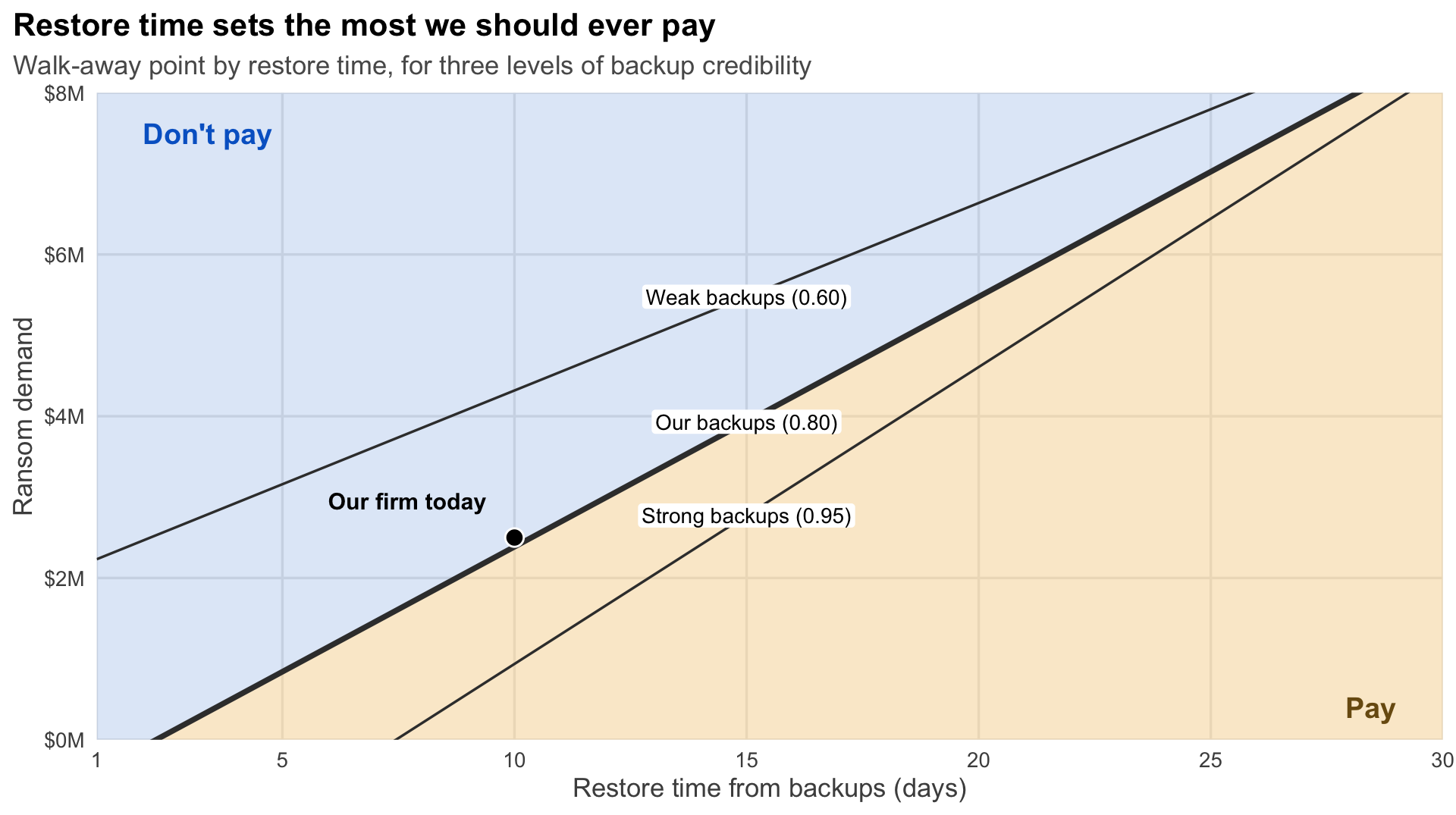
#| fig-cap: "Decision map for the day-one choice. Below a line, paying on day one is cheaper than restoring; above it, restoring is cheaper. The shading shows our firm's backups. The three lines are three levels of backup credibility, the probability that backups restore cleanly."
#| fig-alt: !expr paste0("A chart with restore time from 1 to 30 days across and ransom demand from 0 to 8 million dollars up. Three rising lines mark the walk-away point for weak, our own and strong backups; weak backups sit highest. Our firm, at a 10-day restore and a ", fmt_m(D_BASE), " demand, sits just above its line, in the don't-pay region at the most likely input values.")
#| fig-height: 5.6
lab_x <- 15
labs_df <- wa$boundaries |>
  filter(abs(T_r - lab_x) < 1e-9) |>
  mutate(label = c("Weak backups (0.60)", "Our backups (0.80)", "Strong backups (0.95)")[match(b, c(0.6, 0.8, 0.95))])
decision_map(wa$boundaries, 0.8) +
  geom_line(data = wa$boundaries, aes(T_r, R_star, group = b, linewidth = b == 0.8), color = COL_LINE) +
  scale_linewidth_manual(values = c(`TRUE` = 1.3, `FALSE` = 0.6), guide = "none") +
  geom_label(data = labs_df, aes(T_r, R_star, label = label), fill = "white", label.size = 0,
             size = 3.7, label.padding = unit(0.15, "lines")) +
  annotate("point", x = 10, y = D_BASE, size = 4, color = "white") +
  annotate("point", x = 10, y = D_BASE, size = 3) +
  annotate("text", x = 9.4, y = D_BASE + 0.45, label = "Our firm today", hjust = 1, fontface = "bold", size = 4) +
  annotate("text", x = 29, y = 0.4, label = "Pay", hjust = 1, fontface = "bold", color = "#7a5a12", size = 5) +
  annotate("text", x = 2, y = 7.5, label = "Don't pay", hjust = 0, fontface = "bold", color = COL_NOPAY, size = 5) +
  labs(title = "Restore time sets the most we should ever pay",
       subtitle = "Walk-away point by restore time, for three levels of backup credibility")
```
::: {.reader-note}
**How to read the plot.** Restore time runs across the bottom and the crew's demand runs up the side. Each line is our walk-away point at one level of backup credibility. A demand below the line is worth paying; a demand above it is not. The shaded areas show the pay (amber) and don't-pay (blue) regions for our own backups. The black dot is our firm today: a 10-day restore and a `r fmt_m(D_BASE)` demand.
**What the plot tells you.** Restore time sets where the line sits; the demand only decides which side of it we fall. At the most likely values our firm sits just above its line, with a walk-away point of `r fmt_m(wa$R_base, 2)`. Allowing for uncertainty in every input, paying a `r fmt_m(D_BASE)` demand on day one is cheaper in `r fmt_pct(mc$summary$p_pay_at_base_demand)` of simulated incidents: with today's restore times, this firm is often a rational payer. Weak backups raise the line to `r fmt_m(R_of("Base, weak backups"), 2)` at a 10-day restore.
:::
## Three findings
**Restore time sets the threshold.** The walk-away point does not depend on the demand at all: restore time sets it, and the demand only tests it. Across `r fmt_num(N_MC, 0)` simulated incidents, expected outage time (restore time, backup credibility and rebuild time combined) explains `r fmt_pct(share_of("R_star", "E_T"))` of the variation in the walk-away point. When demands vary over a moderate range, it also explains more of the pay decision (`r fmt_pct(share_of("pay", "E_T"))`) than the demand does (`r fmt_pct(share_of("pay", "D"))`); if demands vary as widely as published payments, the demand comes first ([sensitivity table](governance.qmd#sensitivity)). Cutting restore from 10 to 5 days lowers the walk-away point from `r fmt_m(wa$R_base, 2)` to `r fmt_m(R_of("Fast restore"), 2)`.
**Paying is a poor first move.** The decryptor may fail, decryption itself takes days, the stolen data may leak anyway, a sanctions link can surface after payment, and regulators must be told either way. At the most likely values, paying a `r fmt_m(D_BASE)` demand on day one costs `r fmt_m(wa$C_pay, 2)` in expectation, against `r fmt_m(wa$C_refuse, 2)` for restoring: within about `r fmt_pct(abs(wa$C_pay / wa$C_refuse - 1))` of each other, so the answer depends on the inputs. Restoring first and paying only if backups fail costs `r fmt_m(wa$C_staged, 2)`, less than either.
**A credible refusal means fewer attacks, and credibility requires resilience.** Crews learn from what we do, and a crew that expects less attacks less often. Over 10 years at a `r fmt_pct(P$reputation$p0_base)` annual attack rate, never paying costs our firm `r fmt_m(cost_of("typical", "never"))` against `r fmt_m(cost_of("typical", "rational"))` for paying case by case. The test comes at the first incident, when a fragile firm with a 21-day restore would save `r fmt_m(fr$in_moment_saving)` by paying. In the model, the extra attacks that one payment invites cost it more (present value `r fmt_m(pv_of(eta_b, "fragile", "deviate_once"))` against `r fmt_m(pv_of(eta_b, "fragile", "never"))`), so the policy holds, but only if crews favor firms that have paid before. Without that, paying once is cheaper, and only resilience removes the temptation.
## Decide before it happens
```{r}
#| label: tbl-policy
#| tbl-cap: "Four decisions the board can make before an incident."
tibble::tribble(
  ~Decision, ~`What to set`, ~`Why it matters`,
  "1. Walk-away rule", "Who can invoke a payment, and the walk-away point they must test the demand against",
    "The walk-away point, not the size of the demand, decides whether paying is rational.",
  "2. Restore-time target", "A target for the platform, for example under 5 days, tested at least yearly",
    paste0("Each restore day is worth about ", fmt_m(wa$slope, 2), " of walk-away point; below about ", fmt_num(wa$T0, 1), " days no demand is worth paying."),
  "3. Pre-cleared steps", "Sanctions screening, law-enforcement contact, and the 24-hour NYDFS payment notice",
    "Payment delay and sanctions risk raise the cost of paying; preparation shortens both. As an NYDFS-covered firm, we must report any payment within 24 hours.",
  "4. Default policy", "An internal default of \"we don't pay\", with the narrow exceptions written down",
    "A known refusal means fewer attacks later, but only a policy the firm can afford to keep is believed."
) |>
  gt() |>
  cols_width(Decision ~ px(180)) |>
  tab_style(cell_text(weight = "bold"), cells_body(columns = Decision)) |>
  gt_board()
```
::: {.reader-note}
**How to read the table.** Each row is one decision the board can take now, before any incident. The middle column says what to set, and the last column links it to a finding from this analysis. The four rows follow the order of an incident: who decides, how fast we can recover, what must already be cleared with regulators and law enforcement, and what the firm's default answer is.
**What the table tells you.** The most important decision is the restore-time target, because it moves the walk-away point more than anything else and makes the no-pay default believable. The other three turn a decision made under pressure into one made in advance. None of them requires predicting the size of the next demand. Each can be rehearsed in a tabletop exercise, so the board can check that the decisions hold before a real incident tests them.
:::
::: {.side-note}
**Related work.** This study pairs with a related study of the same firm: the [Defender–Attacker study](https://patrick-lefler.com/defender-attacker-game-theory/) shows how a crew chooses which asset to attack. Outage cost here is set at `r fmt_m(BASE$c)` per day for this study alone.
:::